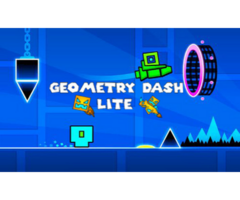

There's a moment every player remembers — the first time the music, the obstacles, and your own hands all click into sync. It feels less like controlling a game and more like conducting a tiny orchestra of neon squares. Geometry Dash has a reputation for being brutally hard, but beneath that reputation is something far more interesting: a game about rhythm, patience, and the strange joy of failing a hundred times on the way to a single perfect run.
I didn't expect to like this game. I'm not a "hardcore gamer," and the idea of memorizing a level down to the exact pixel felt more like homework than fun. Then a friend handed me their phone during a long train ride, and forty minutes vanished. What follows is less a tutorial and more an honest account of how to actually enjoy one of the most punishing — and oddly soothing — games I've played.
The Basic Idea
The concept is almost embarrassingly simple. A square moves forward on its own. You tap once to make it jump. Touch any spike, wall, or other hazard, and you explode into a puff of particles and start the whole level over. That's it. There are no power-ups to collect, no enemies to defeat, no story to unpack. Just you, the beat, and a constant stream of things trying to kill your little square.
The magic is in how that simplicity gets stretched. Some levels have you jump as a straightforward block. Others flip gravity so you're hopping along the ceiling. Some turn you into a tiny ship that you steer up and down, or a UFO, or a wave that moves in sharp diagonal lines. Each "mode" changes the feel of the controls entirely, but the core idea never changes — one tap, timed correctly, moves you forward.
What ties it all together is the music. Levels are built so that every jump, every spike, every drop lines up with the beat of the soundtrack. Obstacles don't just appear; they arrive in rhythm. Once you start to hear that, the game changes from "dodge the spikes" into something closer to a rhythm game wearing the costume of a platformer.
Why It's More Fun Than It Looks
The thing that surprises most newcomers is how fair the game feels. When you die — and you will die, constantly — it almost never feels like the game cheated you. You can see exactly what you did wrong. You jumped half a second too early, or you forgot the spike that comes right after the jump pad, or you panicked during the ship section and overcorrected. Every death is a piece of information.
That's the key to actually enjoying Geometry Dash instead of rage-quitting it: treat each attempt as practice, not as a "run." The player who enjoys the game is the one who stops measuring themselves by how far they got and starts noticing that they got a little further this time. Progress here is quiet and cumulative. You'll blast through the first few levels, then hit one that takes you fifty, a hundred, two hundred attempts. That's not you being bad — that's the game working exactly as intended.
There's also a meditative quality hiding under all the chaos. Because the level layout is identical every single time, your brain eventually stops processing the jumps as conscious decisions. Your hands start reacting to the music before your eyes even register the obstacle. It's the same feeling as typing a well-known song's rhythm on a desk. When it works, it's genuinely hypnotic.
Getting Started Without Losing Your Mind
If the game is new to you, a few habits will save you a lot of frustration.
Start with the official levels. The main "Stereo Madness" and the levels that follow are masterclasses in gradually teaching you new mechanics. They introduce the ship, the gravity flips, the decoration, and the difficulty curve at a pace that makes sense. Resist the urge to immediately jump into the impossible-looking community levels.
Use practice mode. Placing a checkpoint and drilling a specific section over and over is the single fastest way to improve. There's no shame in it — nearly every serious player uses it.
Listen, don't just look. Pay attention to how the music lines up with what's on screen. Most tricky sections become dramatically easier once you sync your taps to the beat rather than to your eyes alone.
Take breaks. This sounds like generic advice, but it's especially true here. There's a well-documented phenomenon in this game where you'll be stuck on a level for an hour, put it down, come back the next day, and clear it on your second attempt. Your brain needs time to file away the muscle memory.
Don't compare yourself to streamers. You'll see videos of people clearing absurdly hard demons with their eyes closed. Those players have thousands of hours of practice. Your only real competitor is the version of you from yesterday.
The Community and the Creative Side
One of the best parts of the game isn't playing levels at all — it's making them. The built-in level editor lets anyone build their own stages, and the community has produced an astonishing range of creations: atmospheric levels that feel like art installations, remakes of other games, auto-play levels that are pure eye candy, and of course, the infamous "demons" that push the difficulty to its absolute limit.
If you never want to create, that's fine too. Just browsing what other people have made is half the appeal.
Final Thoughts
I can't promise you'll love this game. Some people find the repetition maddening, and they're not wrong to. But if you give it a fair chance, you might find something surprisingly rewarding — a game that asks almost nothing of you except attention and patience, then pays both back in full.
There's a reason people still play Geometry Dash years after its release, why they stream it, film it, and spend hundreds of hours perfecting a single run. It's not just about beating the level. It's about the moment everything finally clicks, the music swells, and for a few perfect seconds, you stop thinking and just feel your way to the finish. That moment is worth every one of the hundred deaths that came before it.
 Loading